Bearable words
'Father lives in a very cold place, and in that place it is hard to feel things.' A sentence like this tells the truth and leaves the parent's figure intact in the child's eyes.
A page for families
In a home where a parent drinks, the child learns to read the climate before learning to read words. They learn the sound of footsteps, the tone of evenings, the silence that falls without warning. They grow with a special attentiveness towards others and a question that rarely finds space: who takes care of me?
This page is written for parents, teachers, educators and anyone standing beside a child in this situation. Here Solomon J.'s tale becomes a concrete tool: a story in which the family's pain finds a tellable shape, and the child finds a protagonist who resembles them.
The loneliness of these children has a particular trait: it happens in presence. The parent is at home, yet their attention lives elsewhere. In the tale this takes shape in the Giant, Solomon J.'s father, who lives in the Glacier of Alcolà: a place where cold has become the natural condition of everything.
Many of these children grow up early. They learn to look after the house, their siblings, sometimes even the parent themself. The adults around them see mature, reliable children, and this early maturity is often admired. Inside that maturity lives a silent request for childhood.
And then there is the greater mystery: the child keeps loving. The bond with the parent stays alive even through the cold, and it is exactly this love that the tale protects. Solomon J. crosses the glacier, looks at his father, and discovers that recognising the pain of someone you love is an act of greatness.
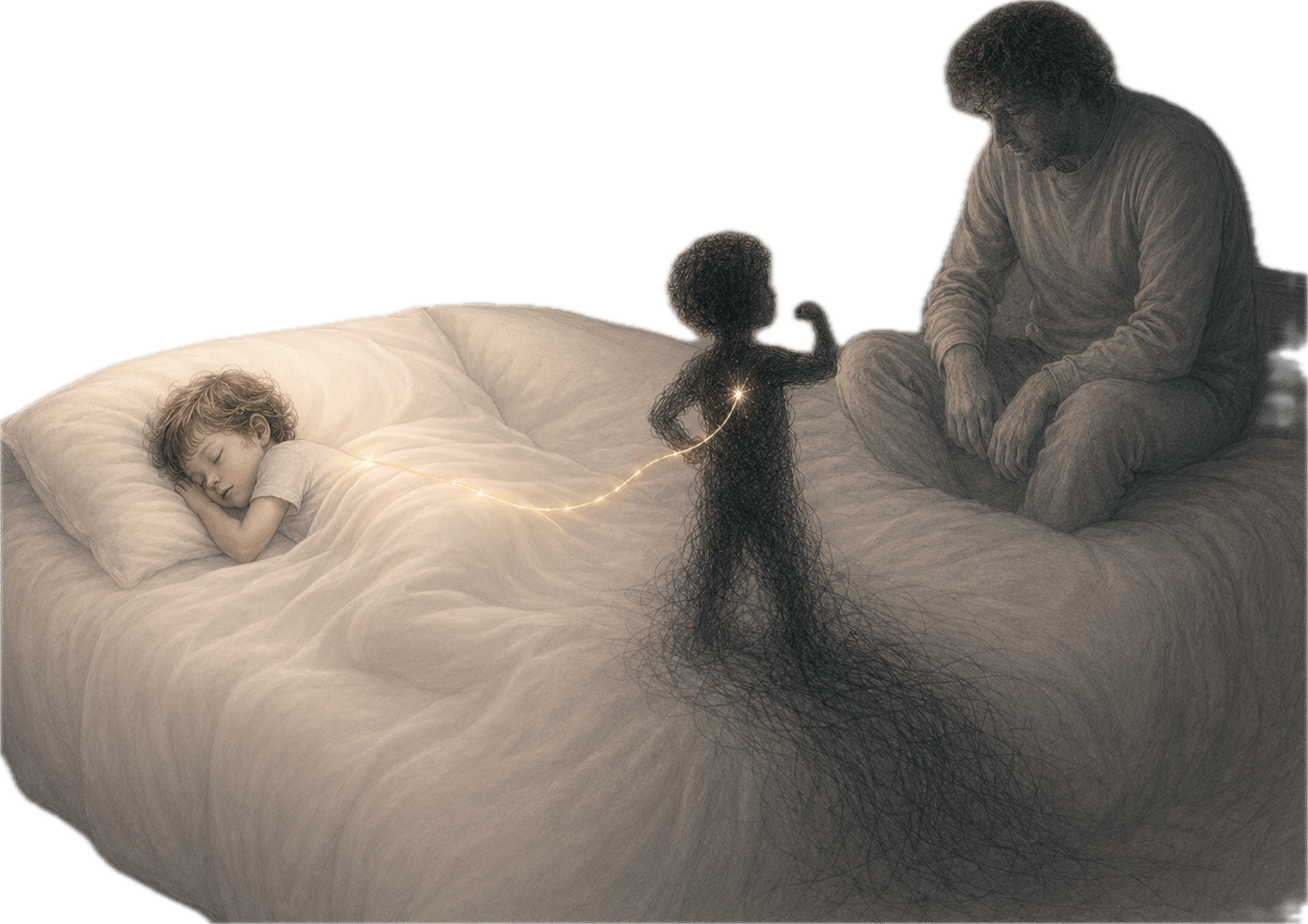
In the story the father has a precise narrative name: he is the Giant. The choice carries a truth children know well, because to a child a parent is always great, even when their pain keeps them distant. The Giant remains lovable and recognisable, and this lets the child reader find their own father again on the page.
The book accompanies Solomon J. through a decisive passage: recognising his father's pain and separating it from his own destiny. There are paths that belong to adults and paths that belong to children. Crossing the glacier and leaving it belongs to the Giant. Finding his own Shadow and keeping his own light belongs to Solomon J.
'Father lives in a very cold place, and in that place it is hard to feel things.' A sentence like this tells the truth and leaves the parent's figure intact in the child's eyes.
'That cold belongs to him, and you have your own climate.' This distinction frees the child from the weight of solving the parent's pain and gives them back their own road.
'There is a thread that keeps you joined, and you can hold it in your hand.' The child's love finds in the tale a safe place, independent from the parent's everyday presence.
The page devoted to Solomon J.'s father: how the tale gives shape to dependency and restores dignity and love to the father figure.
How a child lives the distance of a father, and how the tale gives this absence a name: the Giant.
The metaphor the book uses to speak to children about alcohol and addiction, with words ready to use at home and at school.
What every child carries before any wound: the luminous map Solomon J. uses to cross the cold while staying whole.
How a story manages to name the truth and give the child back their childhood: the narrative method behind the book.
A reading key for the absences children perceive, and the right words for explaining adult dependencies.
The site's entry point: a guided path for parents, teachers and readers meeting this tale for the first time.
Children growing up beside a parent who drinks learn early to read the mood of the house, to care for others before themselves, to grow up fast. They carry a particular loneliness, made of physical presence and emotional absence. In the tale this experience takes shape in the Giant, Solomon J.'s father, immersed in the Glacier of Alcolà.
A child feels the cold long before knowing its name. That is why the tale uses the metaphor of the glacier: the child recognises what they live every day without carrying the weight of adult words, and finds in the story a gentle mirror of their own experience.
By offering true, bearable words, present adult figures, and a story in which the child protagonist crosses the pain and stays whole. Solomon J. recognises his father's pain and separates it from his own destiny: this passage is the therapeutic heart of the tale.
Because the tale names reality without accusing anyone. The Giant remains a beloved father, the ice remains a condition that can change, and the child keeps their own road and their own light. It is a way to open dialogue in the family with gentleness and truth.