Giving it a name
'Father is far away, and this distance can be told.' A figure with a name weighs less than silence, and the child stops guessing alone.
A page for parents and educators
There is an absence a child measures every day, even when no one names it. It shows in other people's gestures, in questions that stay suspended, in a house arranged around a chair that waits. The lack of a father has this particular trait: it takes up space, and the child learns early to live alongside that space.
This page is written for those who stand beside a child living this experience: parents, teachers, educators. Solomon J.'s tale offers a precise narrative tool, because within the story the father has a name and a shape: he is the Giant, and through him the absence becomes something that can be looked at together.
Solomon J. imagines universes where fathers play hide and seek and children keep searching, then wonders what kind of game it is where a child never manages to win. Inside this image lives the experience of many children: the endless search, imagination working at night, the question that weighs more than any other: if I found him, would he stay?
His father is often 'in his own world'. His mother seems to know where he is; Solomon J. still has to discover it. From this distance his journey begins: he sets out to find a place, and along the way discovers he is searching for an answer.
Around him, his mother holds the everyday together and builds a mythology of her own. 'They say it takes a whole village to raise a child. If that's true, I am my son's village.' The tale shows with precision what it means for a single parent to become home, map and company.
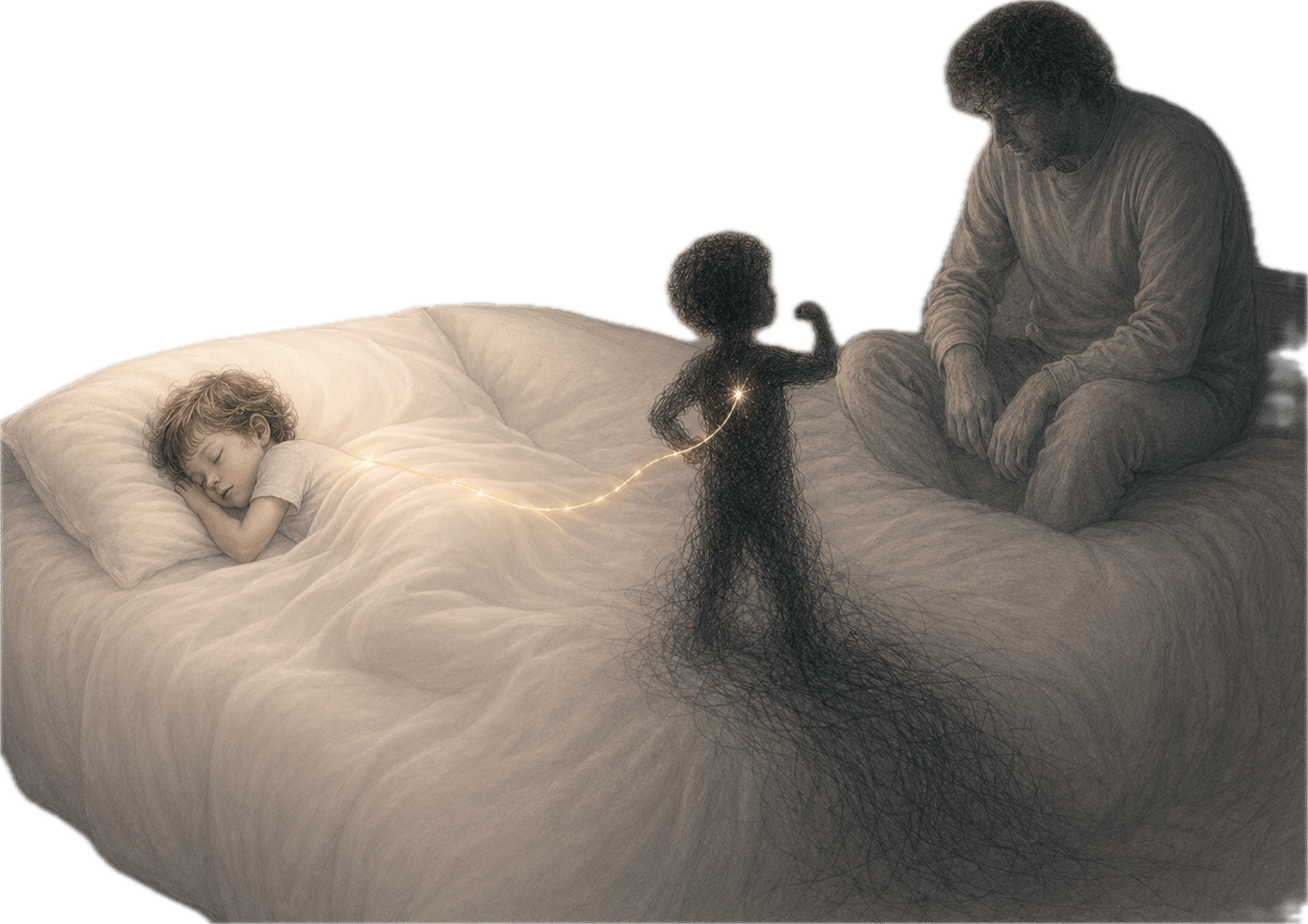
Calling him the Giant changes the scale of things. A giant is seen from afar, occupies the sky, casts a long shadow over the village: that is exactly the measure a father's absence holds inside a child. By giving the absence a figure, the tale makes it observable, and what can be observed can also be crossed.
The Giant lives in the Glacier of Alcolà, and this choice tells a delicate truth: often behind a father's distance lies a pain that keeps him immersed in the ice. The child reader recognises their own father in this great and beloved figure, and discovers that the distance has deep roots that predate their birth.
The decisive passage comes when Solomon J. recognises his father's pain and separates it from his own destiny. There are paths that belong to adults and paths that belong to children. Leaving the glacier belongs to the Giant. Keeping one's own light belongs to Solomon J.
'Father is far away, and this distance can be told.' A figure with a name weighs less than silence, and the child stops guessing alone.
'Father's path belongs to father, and your path is entirely yours.' This distinction gives the child back the freedom to grow along their own road.
The Shadow hands Solomon J. a golden thread, the child's inheritance. Love for the father finds a safe place, and caring for it is already a way of growing.
Discover the Takaró and the other original symbols that make Solomon J. a story of its own kind.
What a child feels when a parent lives inside the ice, and concrete footholds for the adults beside them.
The cloak of stars every child receives at birth: the greatness that stays, even when a father is far away.
By giving the absence a shape, a place and a story. In the tale, Solomon J.'s father is the Giant, a great and distant figure the child can look at without having to resolve it. The metaphor lets the child recognise what they feel without carrying the weight of adult words.
They carry a question that shapes their days and learn early to read the mood of the house. Solomon J. imagines universes where fathers play hide and seek and children keep searching, and wonders what kind of game it is where a child never manages to win.
Because to a child a father is always great, even when his pain keeps him distant. The Giant gives the absence the exact measure it holds inside a child: he occupies the sky, casts a long shadow over the village, and precisely because he has a shape, he can be observed and crossed.
Yes, because the tale names reality gently and hands the child back their own road. Solomon J. recognises the Giant's pain and separates it from his own destiny: the question 'if I find him, will he stay?' slowly stops steering his whole search.