Giving it a name
"Your father is far away, and this distance can be told." A figure with a name weighs less than a silence, and the child stops guessing alone.
A page for parents and educators
Children perceive absences before they can name them. They notice the chair that waits, the voice that fades, the distance that takes up space. When a parent is far away, even while physically present, the child feels that emptiness with their whole body, and searches within for an explanation.
This fable was also written to offer parents a key to reading. A key for recognising the absences their children live through, and for finding the right words when it comes to explaining adult addictions. Inside the story of Solomon J. there are figures, places and gestures that turn difficult experiences into images that can be looked at together.
A child reads the climate of the home before any words. When a parent draws away, from tiredness, from pain or from an addiction, the child registers the change and tries to make sense of it. Often they do this alone, with the tools they have, and the sense they find is almost never the right one.
Solomon J. imagines universes where fathers play hide and seek and children go on searching for them, then wonders what kind of game it is in which a child can never win. Inside this image lives the experience of many children: the endless search, the imagination working through the night, the question that weighs more than the others: if I found him, would he stay?
The tale shows precisely what happens when an absence is left without a name. The child fills it with their own guesses, and carries a weight that is not theirs to carry. Giving the absence a shape, a place and a story is the first gesture that protects the child.
In the tale, Solomon J.'s father is the Giant. A large and beloved figure, who occupies the sky and casts a long shadow over the village. Calling him Giant changes the scale of things: it gives the absence the exact size it has inside a child, and makes it observable. What can be observed can also be crossed.
The Giant lives in the Glacier of Alcolà, and this choice tells a delicate truth: often behind a father's distance lies a pain that keeps him immersed in the ice. Addiction takes the shape of an ice that slows, stiffens, dulls the senses. It is how the tale makes visible the emotional numbing that accompanies addictions, from alcohol to screens to relationships that wound.
Two figures, two truths that the tale places in parents' hands. The Giant names the absence without accusing. The Glacier names the addiction without laying blame. Both leave the adult's figure intact in the child's eyes, and give the child back their own path.
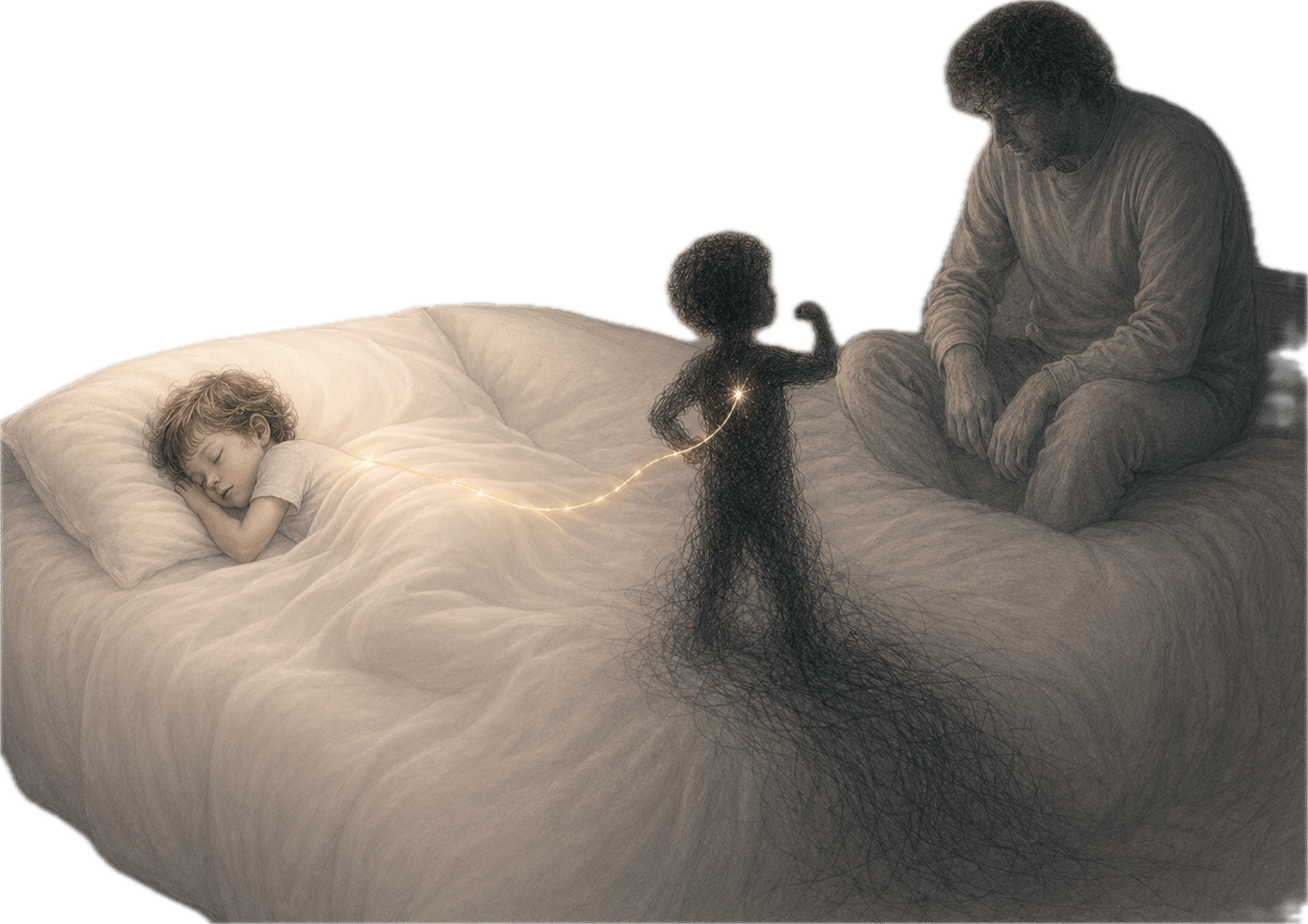
Solomon J.'s mother does not answer her son's questions directly. Instead she builds him a mythology tailored to him, made of places and figures the child can walk through on his own legs. It is a precise choice: it turns a difficult truth into images that can be looked at, and gives the child time to meet them.
"They say it takes a whole village to raise a child. If that is true, I am my son's village." The tale shows clearly what it means for a lone parent to become home, map and company. And it shows that becoming a village does not mean answering everything: it means choosing the words that hold.
"Your father is far away, and this distance can be told." A figure with a name weighs less than a silence, and the child stops guessing alone.
"That cold belongs to him, and you have your own climate." A parent's addiction remains the parent's own. The child's path remains entirely theirs, and growing becomes possible again.
"There is a thread that keeps you connected, and you can hold it in your hand." Love for the parent finds a safe place, and caring for it is already a way of growing.
The Glacier of Alcolà: how the tale makes visible the emotional numbing of addiction, and the simple words for talking about it.
Solomon J.'s father, the golden thread of the Shadow, and the mother who becomes a village.
How a story names the truth and gives a child back their childhood: the narrative method behind the book.
The site's point of entry: a guided path for parents, teachers and readers meeting this tale for the first time.
Because a fable turns difficult experiences into places and figures a child can look at without having to solve them. The distant father becomes the Giant, addiction becomes the Glacier of Alcolà. Parents thus find a shared language, made of images, that names the truth without overloading the child.
With words that keep the truth whole and protect the child from guilt. Solomon J.'s mother builds a mythology tailored to him: she says his father lives in a very cold place, where it is hard to feel things. The child understands the cold, and understands that it belongs to the parent, not to him.
A child perceives the climate of the home before any words are spoken. He notices the chair that waits, the voice that fades, the distance that takes up space. Solomon J. imagines universes where fathers play hide and seek and children go on searching for them: this image holds the experience of many children.
Words that give a name, that separate the paths, and that keep a thread safe. "Your father is far away, and this distance can be told." "That cold belongs to him, and you have your own climate." "There is a thread that keeps you connected, and you can hold it in your hand." The tale offers these sentences already made.
Naming the fatigue
Parental fatigue often arrives in silence: short nights, constant demands, difficult conversations, work, expenses, health. Naming it precisely makes it manageable.
A tired parent remains a capable parent. The difference lies in the support around them, far more than in the amount of energy they can produce alone.
Possible margins
When days are full, small, repeatable interventions work best.
Alliances
Family counselling services, municipal educational services, school listening desks, paediatricians, psychologists and associations offer accessible paths. A first conversation is often enough to find one's bearings.
The school, too, can become an ally: a conversation built on shared understanding gives both sides useful information.
What the child sees
Children register constancy: someone who comes back, who repairs after an argument, who holds the thread of the day. It is this continuity that builds security.