Skip to content

The characters

Who lives in the village

The figures that move through the fairy tale, each carrying a symbolic density of its own.
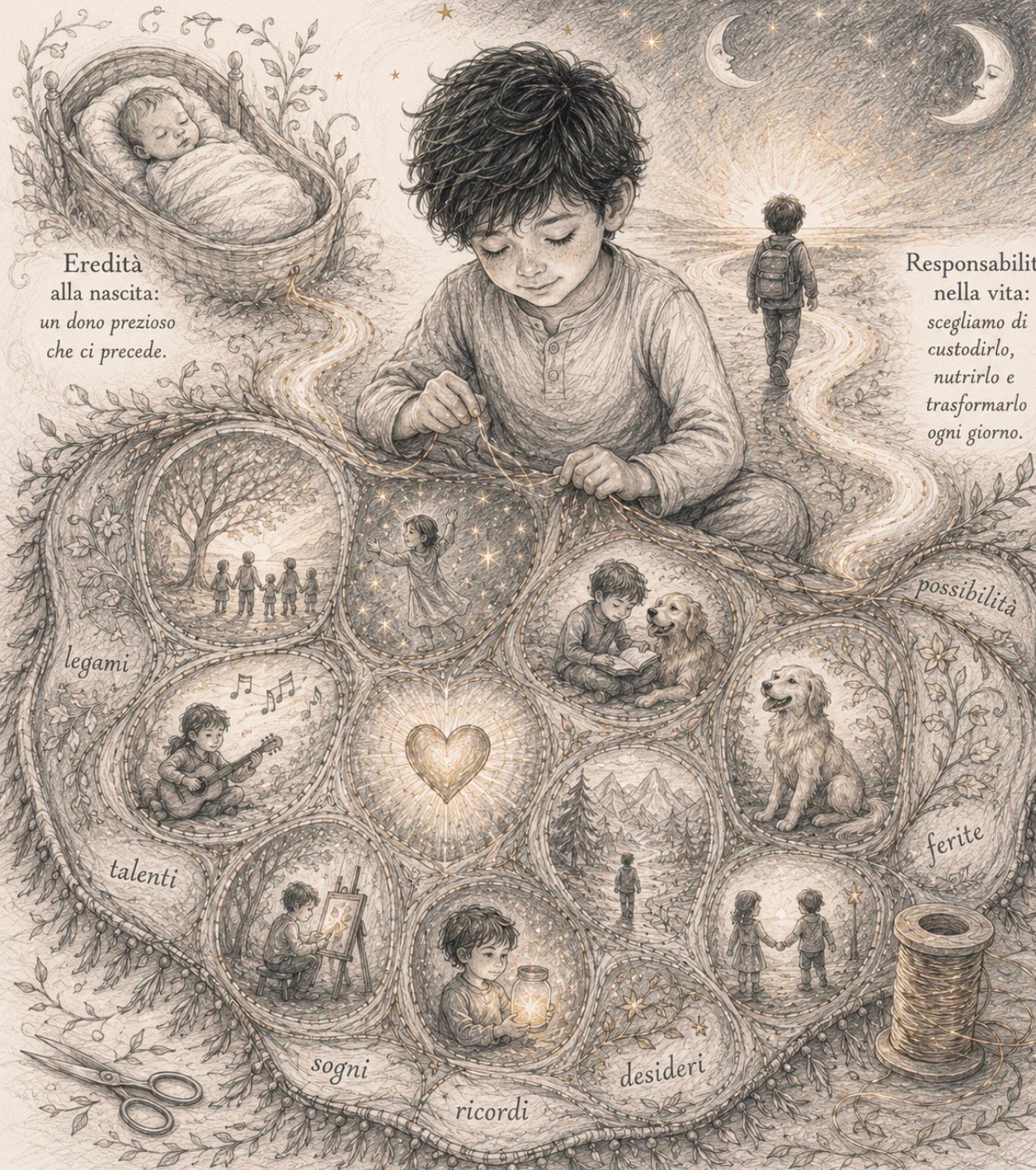
A child sews a blanket of memories, talents, dreams and bonds: inheritance and responsibility
Inheritance at birth, responsibility in life: bonds, talents, dreams, memories, desires, possibilities, wounds.
The protagonist

Who is Solomon J.?

The fairy tale tells the story of a seven year old boy who lives in the town of dead dogs with Madre, the woman who takes care of him. At school the day begins with copying from the blackboard, a spelling test and then the colouring lesson: a place where his way of thinking finds no room. At home, meanwhile, there is a world of invented words, of the questions nobody answers, and of a blanket that arrives before he is born, the Takaró, stitched so that he will not forget where he comes from.

Solomon J. is not a child who calculates: he perceives. His mind works through images, symbols and connections, and the «good boy» mask, the one he tries on when the world around him does not know how to hold what he carries, does not fit him. His watch runs on a different time, and he speaks a language that asks to be translated for adults.

It is Shadow who says it first, in her own way: his thoughts take up too much room. In Madre's eyes he is not «abnormal» but extraordinary, the way every child is in her own way. This is the ground on which the fairy tale grows, without asking anyone for permission.

At school Solomon J. looks for an ally and meets silence: his classmates stay at the window and he passes from group to group. Meanwhile the teacher goes on talking about mountains to colour in and bees to memorise, and on the desks there is a pyramid of numbered glasses of water.

What Solomon J. carries within does not fit into an exercise book. He connects the exact sound of a word with a feeling, and a simple question with a whole world: where his father is, whether «in his own world» is a place one can travel to, and why grown ups stop listening to those who speak about what really matters.

Madre builds for him the language he needs. In the dialogue with the Sunmen she asks her son not to speak like the people of the planets, so as not to resemble them, and reminds him that the second part of the journey through Pepilandia is shaped by his questions, not by his condition.

Solomon J. perceives before he understands. When fear paralyses him, a bubble surrounds him and holds his breath; when he has to cross the cold of the Alcolà, a friendship keeps his gaze alive. His resources are already there, and the story lets them surface at the right moment.

The child's Shadow is his companion in the dark and keeps his unspoken thoughts. When Solomon J. leaves her inside the first bubble, she does not stand still: she sets off alone in search of the Giant, and for the child reaching her again will mean finding his own words back.

His relationship with the village is made of arrivals and departures: Madre who becomes village, the town of dead dogs that stays behind, the houses of the Pepileni that welcome him as he is. Every relationship marks one step of his becoming, and none of them is secondary.

«the more people understand me, the more I feel they do not understand me at all» This is what Solomon J. writes in one of the most exposed passages of the book. The distance from others is not a whim: it is the experience of someone whose language asks for translation.

The turning point takes place in Pepilandia, a village where every difference finds a place. The Sunrise Pepilene, the glowing bridges, the invented creatures teach him something no school had offered him: his gaze has its own dignity.

The fairy tale follows an ascending journey: the village of the departure, the first bubbles, the hidden village, the Sunmen, the glacier, the way back. Every stage leaves something in the child, and nothing of what he learns disappears.

When he takes the Takaró back in his hands, Solomon J. understands its value and the sense of the promise he made as a child. Inside the blanket there is the memory of his original greatness, and the certainty that he had not invented any of it.

The departure from Pepilandia is not an escape but a taking back of his own path: the village remains, the bridges stay open, and the sparkle of the Pepileno accompanies him from the pages of the book into everyday life.

Solomon J. can then return to his own world carrying something more precious than an answer. A measure. The measure of what is good for him, of what deserves to be kept safe, of the bridges worth crossing and of the places where his light can grow without having to grow small.

Solomon J. sets out looking for someone. He ends up finding a place for himself.
Around him

Who walks beside Solomon J.

The woman called by her function

Madre

«If this is true, then I am my son's village»

In the book this woman carries a single name: Madre. Her given name stays off the page, and the word that names her coincides with the function she serves. Solomon J. calls her Madre for the guiding role she has in his life, and calls her mum only when he feels vulnerable, when he needs her presence as a person.

The study of the book describes her like this: «Madre is alone. She faces the care of her child with a second parent who is absent or barely collaborative and with an insufficient network of help. She is a whole mother, marked by personal wounds as a woman and by the strain of care.» It keeps her tiredness within whispered phone calls and liberating cleaning, and what reaches her son above all is warmth: the smells of the kitchen, the playful routines, the comfort of words.

She has an initiatory role: she grasps her son's very high capacity for abstraction and entrusts him to a mythology, a mythology of the absent. She offers a system of decoding that lights up imagination and makes it possible to cross the bridges towards one's own answers. She is the only one who always says her son's name in full, because she welcomes him in his wholeness, recognising every aspect of him.

Around her the book recognises a condition shared by many mothers caring for Neuro Splendente children: the social recognition that is missing, the educational triangulation that is missing, the grief relegated to the margins. The ending opens a transformative perspective, begun and sustained first of all by the maternal figure.

The father

The Giant

In the fairy tale the father is the Giant: a large and distant figure who lives inside a world able to absorb his gaze, his energies, his capacity to inhabit relationships.

Solomon J. imagines universes where daddies play hide and seek and children keep looking for them. He carries with him a question that hurts: if he had found him, would his daddy have stayed? He who would have so, so much wanted a daddy.

The meeting takes place on the Alcolà Glacier. The child observes the Giant immersed in the ice and understands that the distance between them has deep roots and precedes his birth. He recognises his father's pain and distinguishes it from his own destiny.

The closing of the cycle

The Eagles of Hybris

On the Alcolà Glacier the Giant receives from Shadow the little thread of the Takaró, the symbol of the primary bond, and does not grasp its meaning. He wastes it, giving it away to the hungry eagles.

The eagles arrive right after. In the book they switch off a piece of his light, and the study of the book recalls that «the task of facing the Giant's dependency belongs to adults».

Keeping this distinction clear allows the child's desire, anger and questions to receive attention for what they are.

The questions that remain

Shadow

Shadow belongs to Solomon J. and has always been independent of him. She keeps the thoughts the child senses before he manages to tell them, and she stays inside the bubble when he reaches Pepilandia, carrying with her what he has left behind.

It is Shadow who sets off alone in search of the Giant and offers him a thread of the Takaró, hoping to be recognised. His answer helps her understand the limits of that meeting. To find her again, Solomon J. has to speak to her: «Shadows do not hear our thoughts, they only hear our words».

The ally

Layla

Layla appears at the coldest point of the story. She walks beside Solomon J., keeps his gaze safe and offers him the serenity he needs to cross a landscape that would have overwhelmed any child.

Her account makes care an everyday responsibility: taking a dog out, keeping a newborn safe, sharing the tasks, answering those who ask for help. After her death, the memory and the little threads keep the bond with her alive.

The guide

The Pepileno Cucù

He is 4,225 years old and has the air of a classmate. It is he who accompanies Solomon J. into Pepilandia, shows him the places where certain grown ups get lost playing hide and seek in life, and explains that his mission is one's own greatest good.

When he gives the Takaró back to him and tells him «You'll need to care for your Takaró», the gift becomes responsibility: the moment when a child stops waiting and begins to keep himself safe.

The keepers of the Takaró

The Sunrise Pepilene

They keep the Takaró, the cloth of the Universe that wraps every child before birth. Each Takaró is unique, handed over so that the child remembers where they come from and how powerful they are.

They keep watch at dawn, when the sky still holds a little night: the exact moment when a thing begins.

The teachers

The Pepilene Magne

In Pepilandia the Pepilene Magne teach, and their first subject is the gaze. They look at the child before the pupil, and every emotional need they welcome opens the way to a possible learning.

They are the luminous counterpart of those classrooms where knowledge moves at a single pace and being different is mistaken for wilfulness.

The others like him

The Sunchildren

In Pepilandia Solomon J. discovers another word for his own intensity: Sunchild. The «too much» is born from the measure of the one who looks, and here the measure changes.

Some lights make visible paths that before seemed invisible. From that moment the child begins to look for his own world instead of his father's world.

The other inhabitants of the village are waiting for you inside the pages of the book.

Who is the Pepileno and who are the Pepileni

Layla and the spirit of the animals who return