Skip to content

The themes

The territories of the book

The thematic cores that run through Solomon J. nel villaggio dei Pepileni: from high cognitive potential to the Giant, from addiction to the loneliness of a child and his mother, all the way to a fairy tale to read together.

The thematic cores

Giftedness, when intelligence is also sensitivity

A noise becomes pain, an unkind word turns into a wound, an existential question arrives at seven with an adult's urgency. Solomon J. carries this double intensity, cognitive and emotional, and the fairy tale tells it as his own measure, to be recognised even before it is measured.

The Giant, absence with a name

In the fairy tale the father is the Giant. Solomon J. imagines universes where daddies play hide and seek and children keep looking for them, then he wonders what kind of game it is in which a child can never win. He carries a weighty question with him: if he found him, would his daddy stay? The Giant gives absence a body, a place and a story, and allows the child to look at it.

Addiction and the Alcolà Glacier

Solomon J. finds the Giant again in the Alcolà, the glacier where the cold has become the natural condition of everything. There he understands that the distance between them has deep roots. Addictions, from alcohol to screens to relationships that wound, offer an immediate relief that in time reaches joy, spontaneity and presence too. The child recognises his father's pain and distinguishes it from his own destiny.

School: from the standard classroom to the Pepilene Magne

There is a classroom where knowledge moves at a single pace and being different is mistaken for wilfulness, where a diagnosis arrives late and a family is left alone to read signals the school could notice first. And there is the school of Pepilandia, where the Pepilene Magne look at the child before the pupil and make the gaze their first teaching tool.

A mother who becomes a village

«If that is true, then I am my son's village» From here everything begins. A mother who, instead of answering her son's question, builds him a mythology tailored to walk through it, and gives him the tools to walk inside it on his own feet.

The loneliness of the child who feels everything

Feeling different at seven, looking for someone to share the intensity of one's feeling with, learning to shrink something of oneself so as to be easier to hold. Solomon J. knows this strain even before discovering he is a Sunchild.

Shadow and the questions that still matter

When Solomon J. leaves the first bubble, Shadow stays inside, then sets off alone in search of the Giant. Her journey gives shape to feelings and questions that still matter after the child has moved on. To reach her again, Solomon J. has to speak to her: «Shadows do not hear our thoughts, they only hear our words».

Layla and shared care

Layla appears at the coldest point of the story and remembers her life with Madre and Solomon J. Her account makes care an everyday responsibility: walking a dog, keeping a baby safe, sharing tasks, answering someone who asks for help. It shows what happens when that weight rests on one person alone.

The journey from the town of dead dogs to Pepilandia

The passage from a landscape where bonds have gone out to the village that still knows how to welcome, and the return to the same place with a grown gaze.

An original mythology and its archetypes

A mythical imagination built from scratch, echoing archaic cosmogonies and suggestions from the Bhagavad Gītā, and following its own way rather than the canonical fairy tale.

A fairy tale to read together

A language children recognise as their own. The invented words of the tale become a bridge for conversation: an adult can ask what the Alcolà feels like or where they would keep a Takaró, and listen to the child's answer.

The story that gives back

The journey gives Solomon J. back affection, memory, curiosity and imagination, with a growing trust in what he feels. He begins to see all his emotions as friends, and necessary. Some set out with a map; Solomon J. sets out to draw one of his own, knowing only that he wants to be happy.

Five closer looks

In depth

A close look at the intensity of children

In some children perception arrives stronger and earlier: the light of a classroom weighs, a phrase said in passing stays with them for days, a question about the meaning of life appears very early. Thinking and feeling grow together, and an IQ score tells only one part of the story.

Solomon J. embodies exactly this double intensity, cognitive and emotional. The book enters into dialogue with Kazimierz Dąbrowski's theory of positive disintegration, in which some experiences of deep crisis may take part in processes of growth and reorganisation of the personality; the reference remains an interpretive key to Solomon J.'s story, without general descriptive value for gifted children. Hence the invitation to read the child with a gaze that listens, tries to understand what they feel and tries to stay beside them.

In depth

The Giant, when absence takes a body

His father, for example, is often «in his own world». Madre seems to know where he is, Solomon J. still has to find out. So he imagines universes where daddies play hide and seek and children keep looking for them, then he wonders what kind of game it is in which a child can never win. It is from a question like this that his journey begins.

In the fairy tale that father is the Giant: a large, distant figure who keeps occupying the child's thoughts. Solomon J.'s Shadow speaks with him in the night and comes to offer him a golden thread, the inheritance of the son.

The meeting takes place on the Alcolà Glacier. Solomon J. observes the Giant immersed in the ice and understands, perhaps for the first time, that the distance between them has deep roots and precedes his birth. He recognises his father's pain and distinguishes it from his own destiny: there are paths that belong to adults and paths that belong to children. From there the question «if I find daddy, will he stay?» slowly stops steering his whole search.

In depth

Addiction, the winter that becomes climate

The Alcolà is an immense glacier, a world where the cold has become the natural condition of everything. The ice slows, stiffens, preserves and dulls sensation: it is how the fairy tale makes visible the distance of an adult whose attention keeps returning to his own needs.

Alcohol, substances, screens, work, relationships that wound offer an immediate relief that temporarily carries one away from pain. With time that same relief reaches joy, spontaneity, presence, the ability to inhabit one's own life fully.

This is why the Alcolà welcomes people who, before addiction, had known their own winter. The symbol widens understanding and keeps responsibility whole: crossing the glacier and leaving it belongs to those who live there. Solomon J. receives a different task, to find his own Shadow again and keep his own light safe.
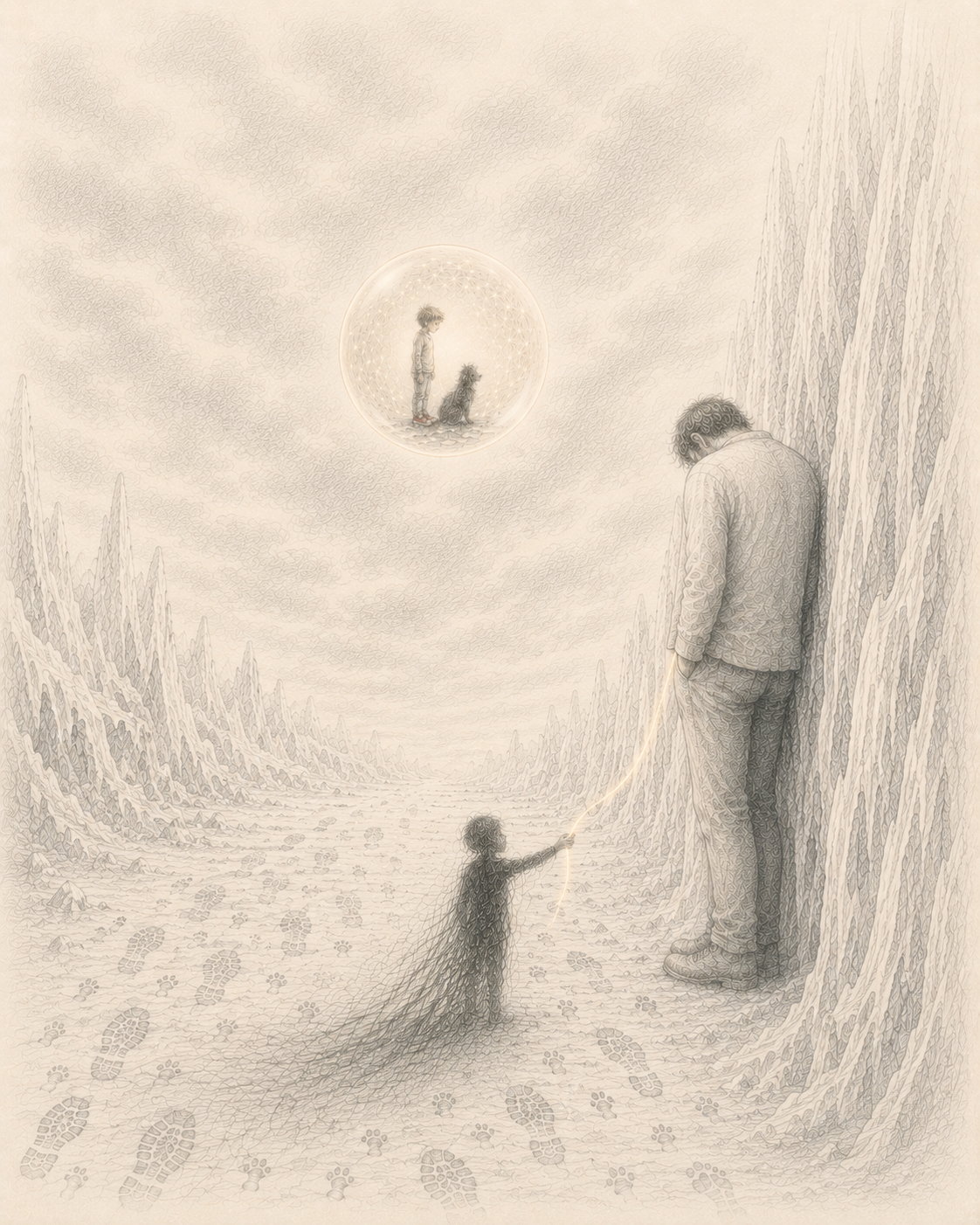
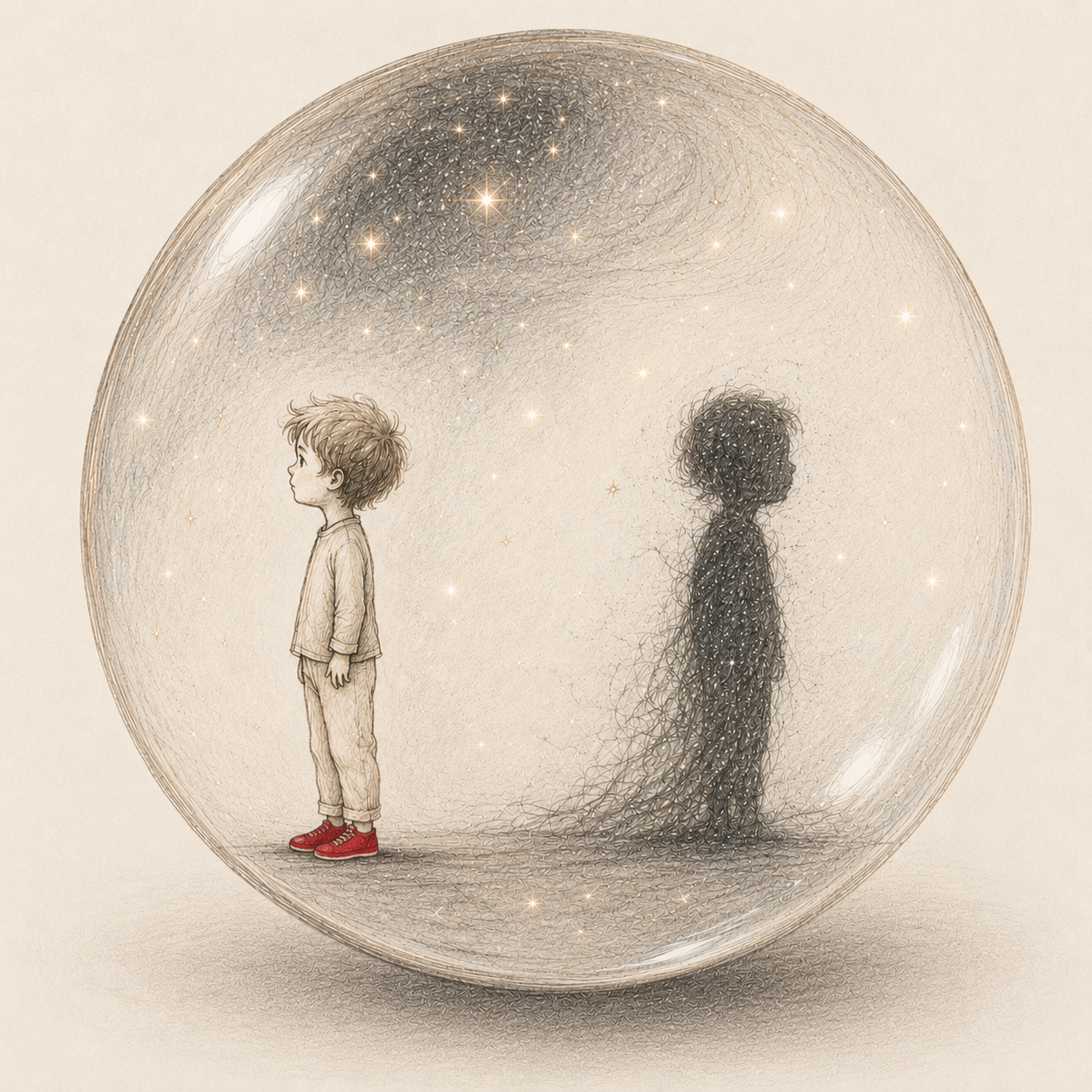
Illustration: an adult seen from behind and a child in shadow joined by a thread of light, with a bubble in the sky
Addiction as anaesthesia: a thread of light still holds the absent adult and the child together.

In depth

Layla, and the limit of every rescue

Layla is the little dog who walks beside Solomon J. right where the cold seems to have reached everything. She walks next to him, keeps his gaze safe and offers him the serenity he needs to cross a landscape that could have overwhelmed any child.

Her presence says two things at once. The first: even in the hardest moments there is a relationship able to steer the journey and preserve trust in life. The second, harder: every rescue has a limit, and there is a point beyond which another's road remains their own. Layla teaches it without saying it, by staying.

In depth

Loneliness, of the child and of the mother

There is the loneliness of the child who feels different and struggles to find peers with whom to share the intensity of his feeling. And there is that of a mother who accompanies that child alone, in a society still learning to recognise high potential.

«If that is true, then I am my son's village» This sentence runs through the whole book. The village of the Pepileni is the imaginative answer to that loneliness: a mother who, instead of answering her son's question, builds him a mythology tailored to walk through it, and gives him the tools to walk inside it on his own feet.

Illustration: a child inside a transparent bubble watches his own shadow beneath a sky of stars
The first bubble: fear stops the journey, and Solomon J. finds within himself the resources to set out again.

The same themes also live in the illustrations.