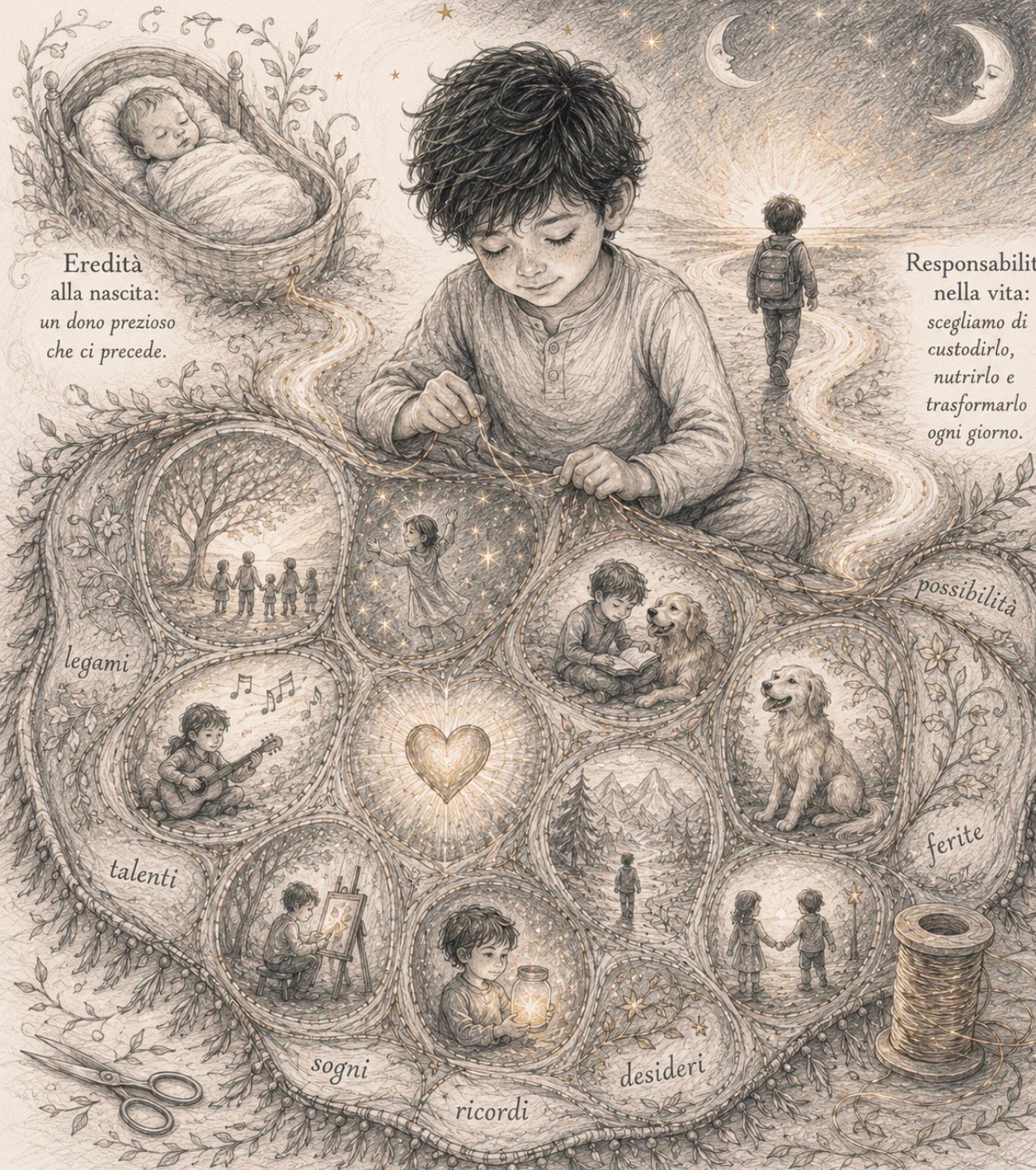
The fairy tale tells the story of a seven year old boy who lives in the town of dead dogs with Madre, the woman who takes care of him. At school the day begins with copying from the blackboard, a spelling test and then the colouring lesson: a place where his way of thinking finds no room. At home, meanwhile, there is a world of invented words, of the questions nobody answers, and of a blanket that arrives before he is born, the Takaró, stitched so that he will not forget where he comes from.
Solomon J. is not a child who calculates: he perceives. His mind works through images, symbols and connections, and the «good boy» mask, the one he tries on when the world around him does not know how to hold what he carries, does not fit him. His watch runs on a different time, and he speaks a language that asks to be translated for adults.
It is Shadow who says it first, in her own way: his thoughts take up too much room. In Madre's eyes he is not «abnormal» but extraordinary, the way every child is in her own way. This is the ground on which the fairy tale grows, without asking anyone for permission.
At school Solomon J. looks for an ally and meets silence: his classmates stay at the window and he passes from group to group. Meanwhile the teacher goes on talking about mountains to colour in and bees to memorise, and on the desks there is a pyramid of numbered glasses of water.
What Solomon J. carries within does not fit into an exercise book. He connects the exact sound of a word with a feeling, and a simple question with a whole world: where his father is, whether «in his own world» is a place one can travel to, and why grown ups stop listening to those who speak about what really matters.
Madre builds for him the language he needs. In the dialogue with the Sunmen she asks her son not to speak like the people of the planets, so as not to resemble them, and reminds him that the second part of the journey through Pepilandia is shaped by his questions, not by his condition.
Solomon J. perceives before he understands. When fear paralyses him, a bubble surrounds him and holds his breath; when he has to cross the cold of the Alcolà, a friendship keeps his gaze alive. His resources are already there, and the story lets them surface at the right moment.
The child's Shadow is his companion in the dark and keeps his unspoken thoughts. When Solomon J. leaves her inside the first bubble, she does not stand still: she sets off alone in search of the Giant, and for the child reaching her again will mean finding his own words back.
His relationship with the village is made of arrivals and departures: Madre who becomes village, the town of dead dogs that stays behind, the houses of the Pepileni that welcome him as he is. Every relationship marks one step of his becoming, and none of them is secondary.
«the more people understand me, the more I feel they do not understand me at all» This is what Solomon J. writes in one of the most exposed passages of the book. The distance from others is not a whim: it is the experience of someone whose language asks for translation.
The turning point takes place in Pepilandia, a village where every difference finds a place. The Sunrise Pepilene, the glowing bridges, the invented creatures teach him something no school had offered him: his gaze has its own dignity.
The fairy tale follows an ascending journey: the village of the departure, the first bubbles, the hidden village, the Sunmen, the glacier, the way back. Every stage leaves something in the child, and nothing of what he learns disappears.
When he takes the Takaró back in his hands, Solomon J. understands its value and the sense of the promise he made as a child. Inside the blanket there is the memory of his original greatness, and the certainty that he had not invented any of it.
The departure from Pepilandia is not an escape but a taking back of his own path: the village remains, the bridges stay open, and the sparkle of the Pepileno accompanies him from the pages of the book into everyday life.
Solomon J. can then return to his own world carrying something more precious than an answer. A measure. The measure of what is good for him, of what deserves to be kept safe, of the bridges worth crossing and of the places where his light can grow without having to grow small.
Solomon J. sets out looking for someone. He ends up finding a place for himself.