What he leaves behind
The barrenness of bonds
Silences, glances that slide past, adults caught up in other things, relationships that go out before they catch light. Loneliness within rooms and within classrooms.
The places
The circular journey
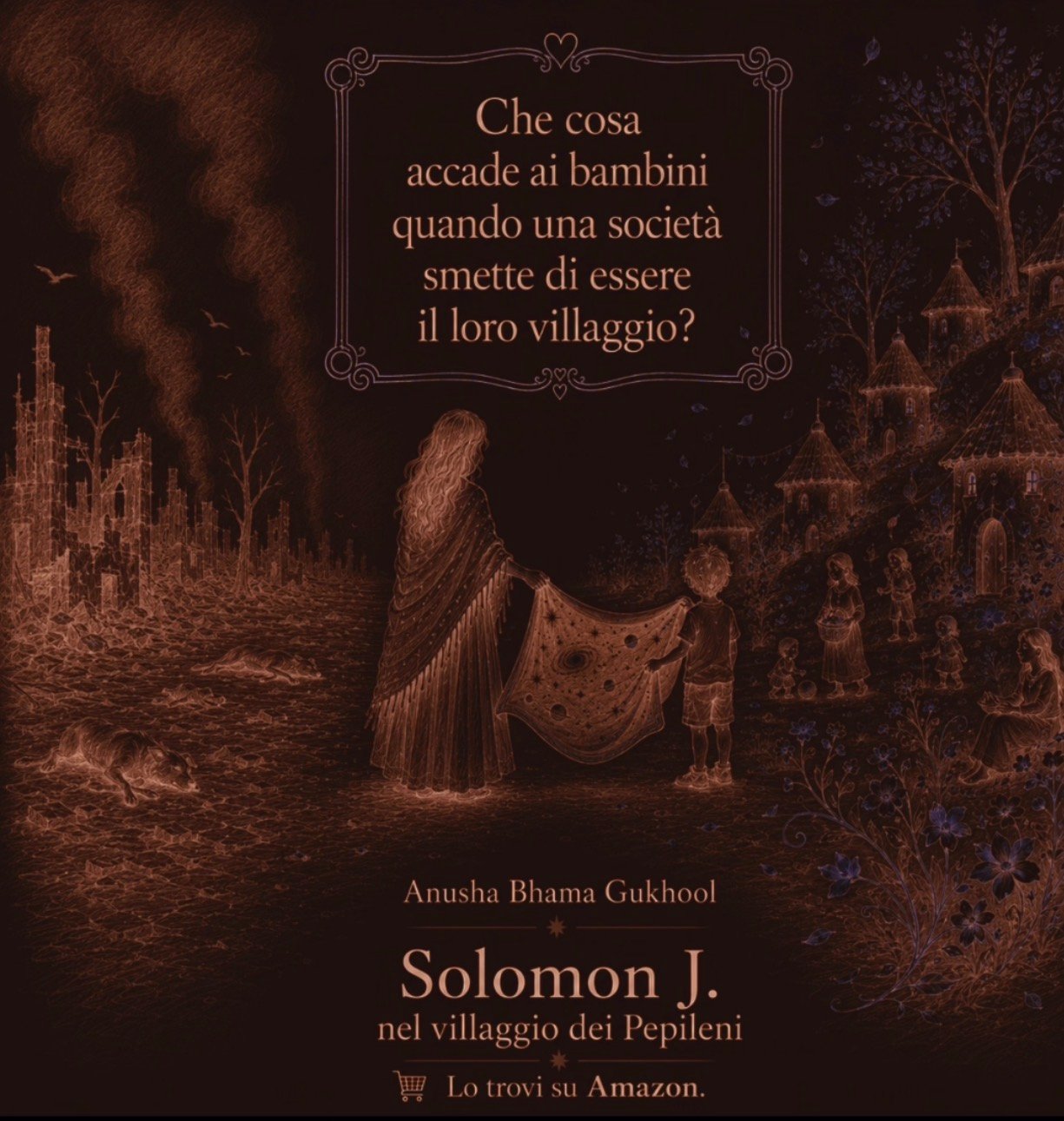
Solomon J. leaves a town where the bonds have gone cold and journeys through a village that still knows how to welcome. Then he returns to his starting point: the same place, a changed gaze.
Silences, glances that slide past, adults caught up in other things, relationships that go out before they catch light. Loneliness within rooms and within classrooms.
Voices that call him by name, encounters that plant seeds, a time that still has the patience to wait for a child. Every presence leaves in him something that will go on flowering.
He returns to the same place with a gaze that has grown. He carries with him the seeds he received and becomes himself a village for those who come after, and his future opens up.
A place from the tale
The winter of a life that leads to addiction
Among all the places in Pepilandia, the Alcolà Glacier holds one of the deepest and most painful experiences in the whole tale. Solomon J. arrives there following his own Shadow, which has set out on a path of its own, carrying with it a part of his identity. The search leads the child into harsh territory, one that becomes one of the most important passages of his growth.
Layla appears to accompany him there. Her presence takes on a particular meaning precisely because it arises in the place where the frost seems to have reached everything. Layla leads Solomon J. towards understanding. She walks beside him, watches over his gaze, and offers him the calm he needs to cross a landscape that might have overwhelmed any child. Her closeness is a reminder that even in the hardest moments there is always a relationship able to guide the way and to keep faith in life alive.
The Alcolà appears as an immense glacier, a world in which cold seems to have become the natural condition of everything. The landscape carries a symbolic weight that goes beyond its description. The ice slows, stiffens, preserves and dulls feeling. Every element helps to tell a human experience that the tale chooses to express through the language of symbol.
The Alcolà Glacier speaks of emotional numbness.
In life, pain naturally seeks some form of relief. Some people meet welcoming relationships, dependable figures and settings that help them make sense of their own experience. Others live through long inner winters, and come to know the frost of abandonment, of loneliness, of fear, of rejection or of broken affection. Every story follows its own path, and some lives come to build ways of surviving that make it possible to soften what seems too hard to bear.
The Alcolà is born of this very insight. Its ice makes visible the way prolonged suffering can turn into a gradual numbing of feeling. Alcohol, substances and every form of addiction offer an immediate relief that carries a person temporarily away from pain. Over time, that same relief reaches joy too, spontaneity, presence, the capacity to share deep relationships and to inhabit one's own life fully. The frost then becomes the symbol of a sensitivity protecting itself by steadily reducing its contact with the world.
For this reason the Alcolà gathers people who, even before addiction, had already known a winter of their own. The tale invites the reader to look upon this place with eyes able to recognise the complexity of human stories. Every inhabitant of the glacier carries a personal path, experiences woven together with their own responsibilities, their own choices and their own possibilities for change. The symbol thus widens our understanding of addiction while keeping individual responsibility whole. The two dimensions live side by side and speak to each other throughout the tale.
When Solomon J. finds his Shadow again, he also discovers the Giant. Meeting his father comes as a revelation along his path of self discovery. Solomon J. watches his father immersed in the Alcolà and understands, perhaps for the first time, that the distance between them has deep roots. The Giant lives within a world that has gradually swallowed his gaze, his energy and his capacity to fully inhabit his relationships. The child is finally able to give meaning to an absence that, until then, had mostly taken the shape of questions.
This understanding gives rise to one of the most delicate passages in the tale. Solomon J. recognises his father's pain and sets it apart from his own destiny. His growth takes shape precisely at the moment he understands that each person walks a different road. There are paths that belong to adults and paths that belong to children. The responsibility of crossing the Alcolà, and of finding a way out of it, belongs to those who live there. Solomon J. is given a different task. To find his Shadow again, to keep watch over his own light, and to continue the journey.
Seen in this light, the Alcolà Glacier widens the meaning of the tale and offers a reflection that touches everyday life. Many children grow up alongside situations they struggle to understand. Some encounter addiction, others live through relationships marked by deep fragility, still others watch adults caught in inner battles that began long before they were born. Solomon J.'s search suggests that every child has the right to know their own story through words able to bring understanding, continuity and trust. Understanding an adult's path allows many feelings to be named. Continuing one's own journey allows the future to be kept safe.
The Alcolà thus takes its place within the new mythology of Pepilandia as the place of emotional survival. Through the language of the tale, the glacier invites the reader to see addiction as the outcome of complex human paths, in which suffering, responsibility, the possibility of change and the wish to find shelter from pain all live together. Solomon J. crosses this place, comes to understand it, and takes up his journey again. His course continues towards the light, because every Sun Child grows by recognising their own story and choosing, day after day, the path they wish to build.